11 min read
Rethinking Robotics Research in the AI-Native Age
research · thoughts
Recently, I was invited to give a talk at the Stanford Vision Seminar. Instead of giving a purely technical talk, I decided to also share some recent reflections on doing research in this age. The talk seemed to be well received, so I organized part of it into this blog post. The talk ended with an open discussion that I couldn't replicate here, so consider this an invitation to continue it. I hope some of this helps, and I'd love to hear how you're thinking about these questions.
The following text was adapted from the talk transcript.
So the title of this talk is "Rethinking Robotics Research in the AI-Native Age". That sounds pretty serious. The subtitle is perhaps closer to the truth, which is "a story about my FOMO and how I've been coping".
Whether you're a student or a faculty member, some of you might feel that FOMO too -- seeing that every few days there's a new demo, a new model, a new startup, and wondering how to work on something that will stay relevant. I don't have a clean answer, but I thought I could offer some personal experience. So in this talk, I will go through my own research path, my belief updates over the years, and some advice I would give when people ask.
For context, I spent some time debating whether I should give a regular technical talk or something a bit different. I decided on the latter because I thought it might be more fun. This is my first time giving this talk, and I hope you'll enjoy it.
I'll start by introducing who I am, walk through my PhD journey, share some recent reflections, and end with an open discussion that I hope you'll all join.
Who Am I
First, a quick self-introduction. My name is Toru. I did my Bachelor's and MEng in CS at MIT. Then a PhD in AI and robotics at UC Berkeley, during which I also interned at / visited NVIDIA and Meta. I'm now a member of technical staff at Amazon's Frontier AI & Robotics lab in San Francisco, working on a number of exciting things. My main research areas have been dexterous manipulation and sim-to-real RL, though I also dabble in other areas such as humanoid whole-body control.
My PhD Journey
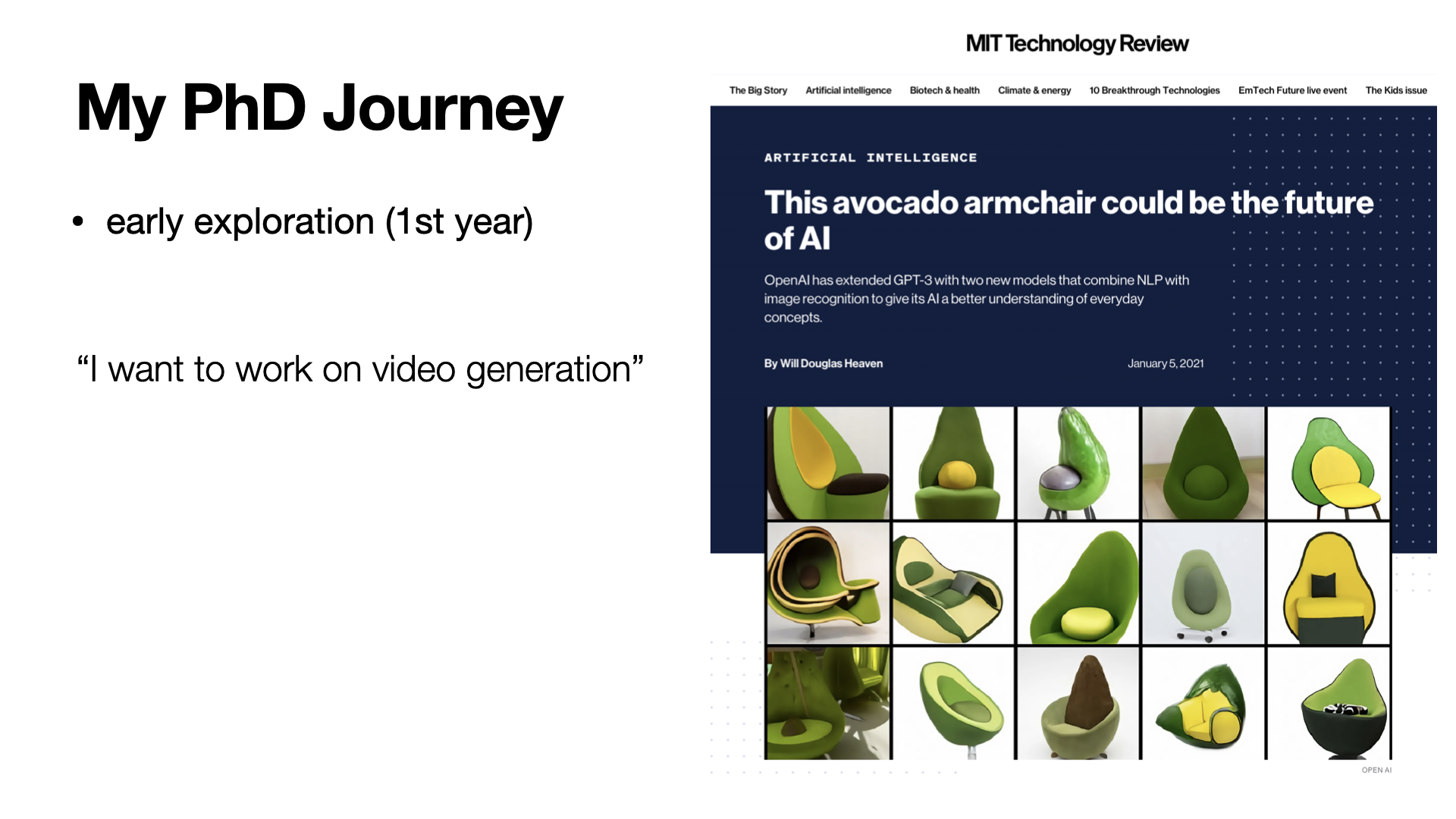
When I started my PhD in 2021, I actually wanted to work on video generation. OpenAI's DALL-E had just come out, and it seemed like an incredibly exciting time for generative modeling. It also felt like research labs in the industry were gaining momentum, and many of the more senior PhD students I spoke with were graduating early to join those labs.
I went to my advisor at the time and told him I wanted to work on video generation. He basically said, probably not, because our academic lab didn't have the compute. So I said "ok" and went back to exploring what I could work on.
By my second year, I realized that what excited me most was the idea of building an intelligent agent that could learn autonomously by interacting with its environment. That led me toward RL and continuous control. And I finally got my first grad school publication out between my second and third year. My collaborator, a very nice senior student, graduated and went to OpenAI halfway through the project. So while finishing that first PhD publication, I found myself reflecting on the struggles I had with finding a research direction and getting something published, and I seriously considered quitting.
But before giving up, I decided to make one last attempt; I thought it could be fun to bring autonomous learning to real robot systems. When I told my advisor about that, he said another professor would be very interested. This other professor, Jitendra, turned out to be a perfect match and later became my advisor for the rest of my PhD. So fortunately, with his support, instead of quitting grad school, I found my way into robotics.
Here's a fun fact: I hadn't actually touched a real robot until 2023. And now robotics has become my area of expertise. So if you're thinking about entering a new field and feeling like everyone else already has a huge head start, it's never too late!
The research interest that I found during the second year of my PhD stayed with me, and eventually turned into my PhD thesis, titled "Embodied Intelligence from Autonomous Experience". Starting from the idea of building a continual learning loop, my thesis work investigates how to acquire the necessary priors, learn generalizable skills efficiently, and build a self-improving robot in the real world -- with a focus on dexterous manipulation.
I'll skip the technical content here -- my thesis is online for those who are interested :P
I graduated earlier this year, and I am deeply grateful to all the supportive advisors, mentors, and collaborators whom I met along the way.
Recent Reflections
Zooming out, the field looks very different from when I started. There are many more players: startups in hardware, models, data, and evaluation, alongside the big labs that were already doing robotics or have newly joined. The recipe keeps evolving too. Over the past year, we've seen VLAs, world-action models, and now agentic robotics; we'll see how things play out. And needless to say, the tools that we now work with are very different from what I had for most of my PhD. I feel very fortunate to be part of the first generation of PhDs who can complete their thesis with AI assistance.
But the worries are also real. Recently, I've been asked quite a few questions by students who are just starting their PhDs or thinking about doing a PhD. Their concerns largely boil down to three questions, and I'd like to share a few thoughts based on my own experiences.
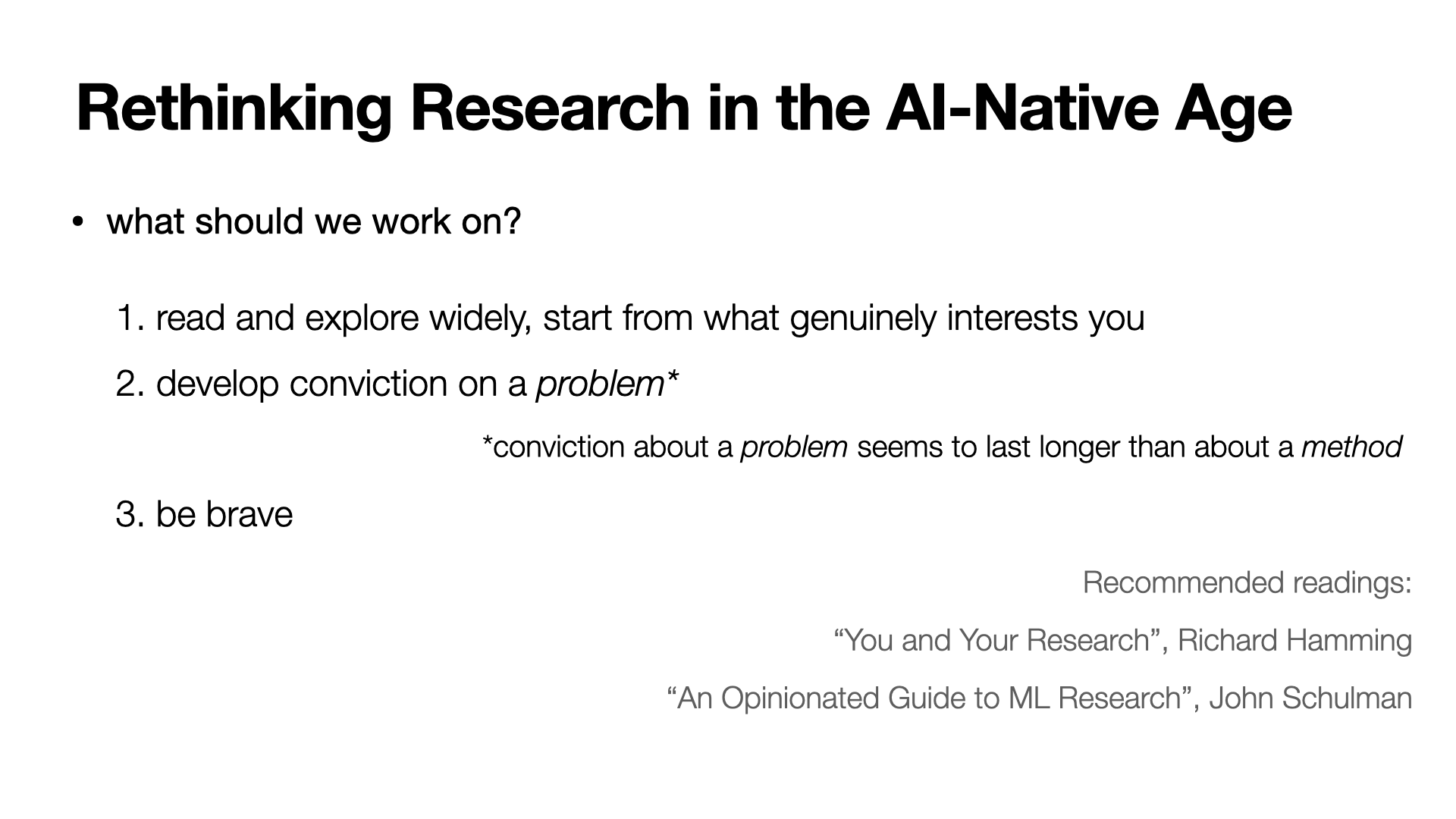
First, what should we work on. My immediate answer might sound conventional: read widely, explore different directions, and start with something that genuinely interests you. Then, try to find a problem for which you can develop conviction. By conviction, I mean believing that you have to work on a problem because it's unsolved and it matters that someone solves it, not because you think it's trendy or "safe to work on".
And one observation I have is that conviction about a problem seems to last longer than conviction about a method. If your research direction is defined entirely by a particular model architecture or the latest technical trend, there's generally a high possibility that the field will move on before you finish your project. But if you start from a fundamental problem that you believe is both important and unsolved, you'll have more freedom to change your methods as new tools become available.
Looking back, I learned this firsthand. In my first year, I wanted to work on video generation because it was the most exciting thing happening at the time, not because I had real conviction about it. The topic that I found in my second year -- building an agent that learns autonomously from its own experience -- was different, and it stayed with me.
My final piece of advice on this question is to be brave. One of the greatest advantages of being in academia, in my view, is the freedom to work across disciplines. That might mean collaborating with a lab that approaches the same problem using very different methods, exploring other problems in the same field, or venturing into neighboring fields (e.g. from robotics to natural sciences, mechanical engineering, or human-computer interaction).
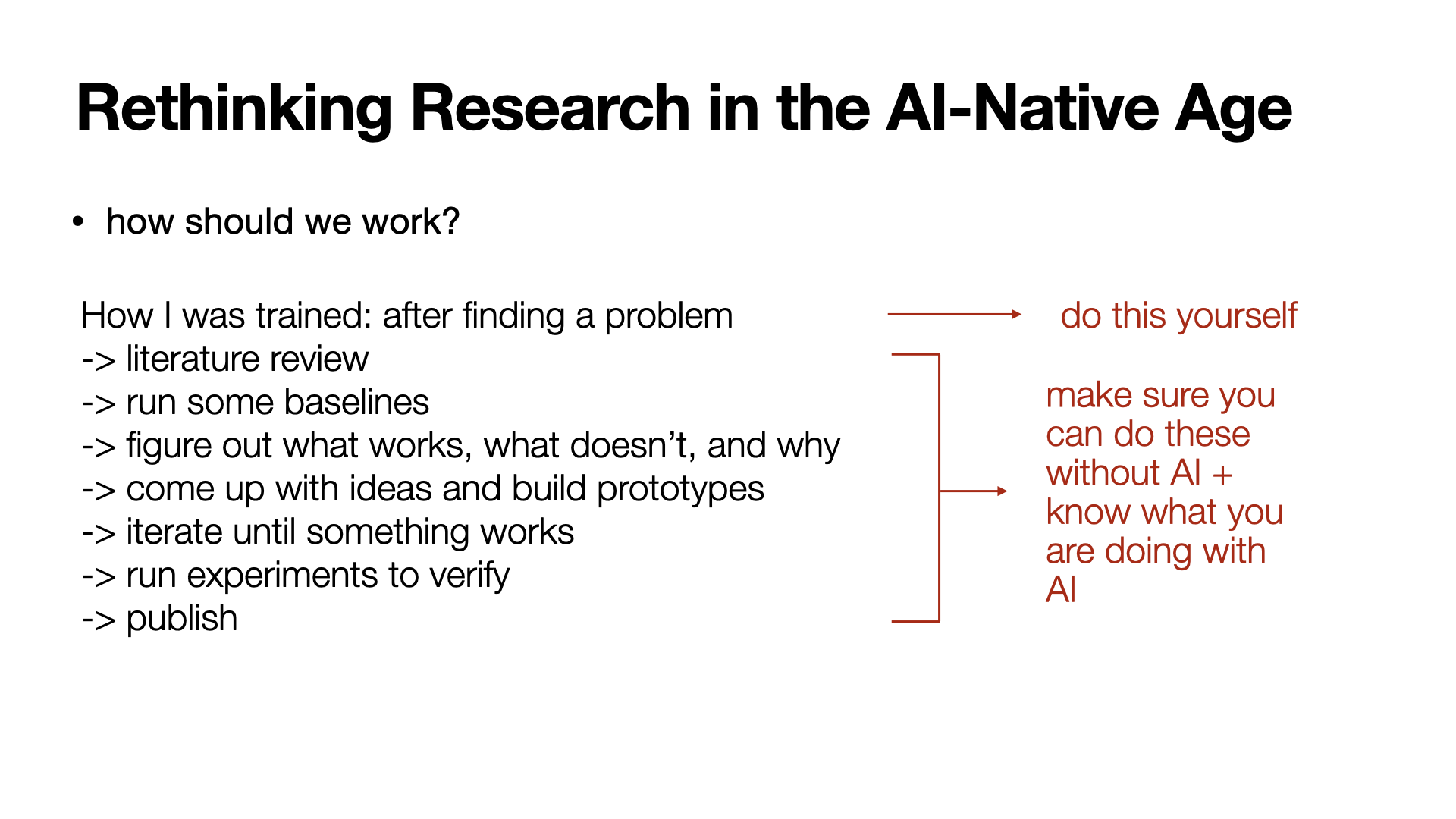
The second question is how we should actually do research as AI becomes increasingly capable.
As a recent PhD graduate, I've been feeling both fortunate and lost. On one hand, AI tools have dramatically increased my research productivity; on the other hand, they make me question the whole point of my existence as a researcher.
In the past, my job was straightforward: I find a problem to work on based on personal interests and my own sense of the state of the field, I read lots of papers, I talk to other researchers, I implement stuff to find out the real pain points and figure out potential improvements, I form some hypotheses about what makes things work better, I run some experiments to test them, and I write all the findings into a report for publication. The same loop repeats as I work on more projects, with growing scope and ambition.
What I've noticed is that AI can take on bigger and bigger pieces of that loop. And it can be very tempting to "just ask Claude / Codex" to also automate bigger and bigger pieces of our own research. As more of the technical components of research become automated, it seems that researchers' leverage will increasingly move toward a higher level of abstraction: choosing and defining the right problems, and exercising judgment about what the results actually mean.
But then, that high-level taste and judgment don't just come from nowhere. In the past, it was precisely through the mundane trial and error -- the very process that is being automated away today -- that researchers developed the so-called "scientific taste".
So my advice is to focus on doing the high-level thinking ourselves, while also getting enough hands-on practice to develop the skills that support it. We should make sure that we, too, are gaining experience and learning when we use AI, so that AI doesn't take away our ability to learn.
Some argue that, if taste is cultivated from experience, AI could develop better taste since they can learn from far more experience in far less time. That's a real possibility, and I'm seeing new initiatives trying to distill research chain-of-thought into models. My hope is that, in that case, our role will just move up another level in the decision-making chain, assuming that at the top of this chain there will always be something that requires fundamentally human input.
In short, whatever happens, don't blindly delegate a piece of work without developing the understanding needed to evaluate it.
Lastly, a question I get asked a lot recently: how to approach PhD and publication going forward.
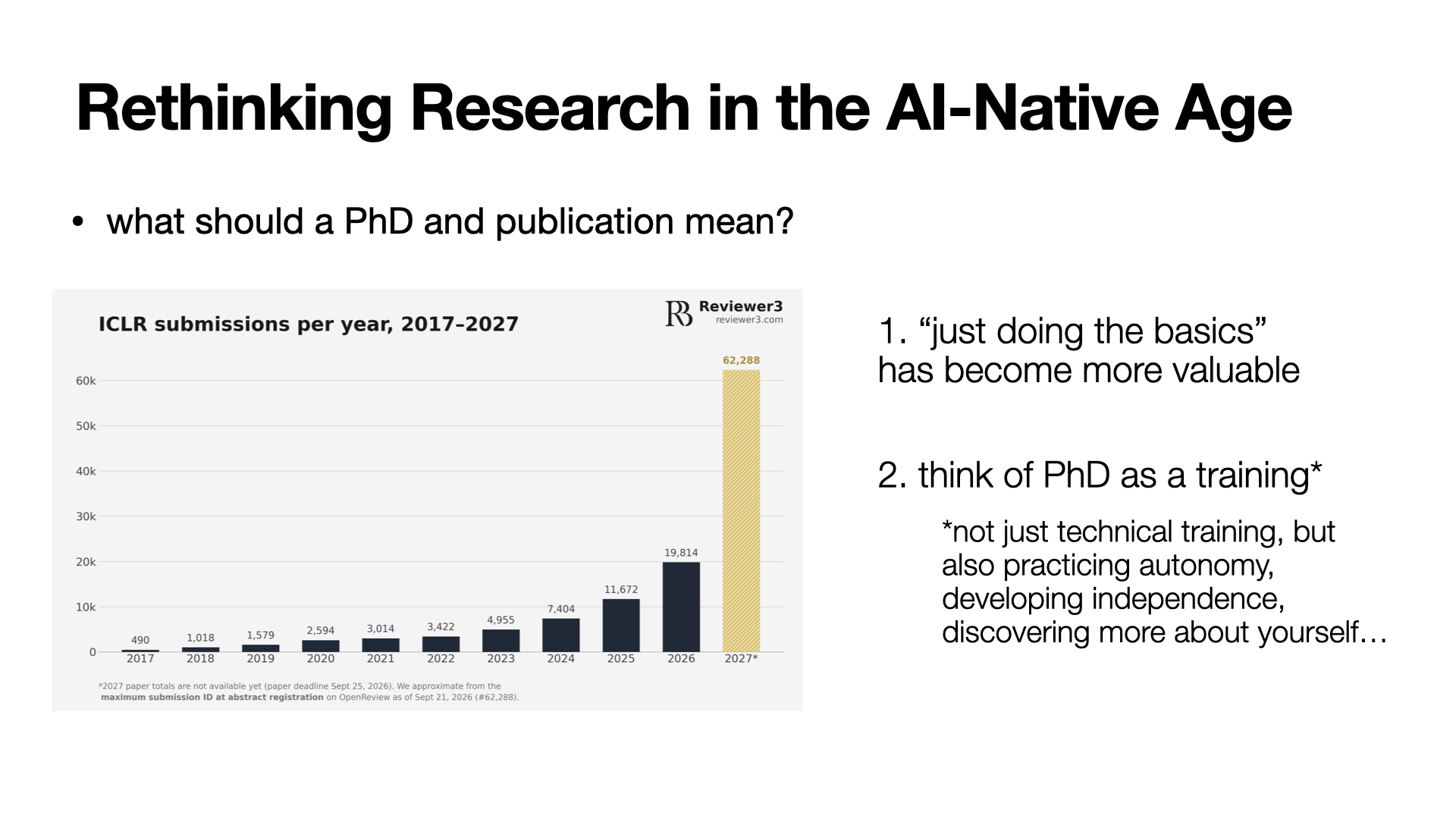
Let's talk about publication first. It's daunting to see the enormous growth in the volume of research being produced, likely in part because AI is increasingly capable of automating the research process.
But here's one thing I noticed while reviewing papers this year. The quality of papers within a single batch varied much more than in past years. And papers that were genuinely thoughtful and technically rigorous actually stood out much more clearly. AI seems to amplify both strengths and weaknesses, making it clearer who had put in the thought and effort and who had just rushed something out.
My takeaway is that, with so much AI slop out there, just "doing the basics well" has become more valuable.
My last piece of advice is about how to approach the PhD journey itself. I think a PhD was originally meant to be a period of training, focused more on developing one's skills than on producing the most impactful results of one's career. That view drifted for a lot of us in recent years, and maybe it's time for the PhD journey to go back to being training.
This connects back to the second question. If trial and error is how taste gets built, and AI makes it easier than ever to skip that process, then PhD might be one of the few years in our career when we can be given the space to do things the slow way and actually learn from it.
And while technical skills matter, they're also not the only thing you can learn through a PhD. Think of it as a few years to practice autonomy and independence. And use it as an opportunity to learn more about yourself: What kind of career do you want? What are you truly passionate about? What would you still work on after you retire?
Closing Thoughts
Finally, I'll relate back to my own story. I know how stressful it can be to be a PhD student right now. It's easy to feel FOMO, or like you're falling behind. I've experienced a lot of those feelings myself. As I mentioned at the beginning of this talk, I was lost for most of my first two years, and I almost quit (which would have been ok too!).
But we don't have to find our problem in year one, and we don't have to rush past the parts where we are learning.
Life is very long. And we have time.
This is how I've been coping. And I hope my talk has helped.
Thank you!